|
Website visitor Steve S. asked
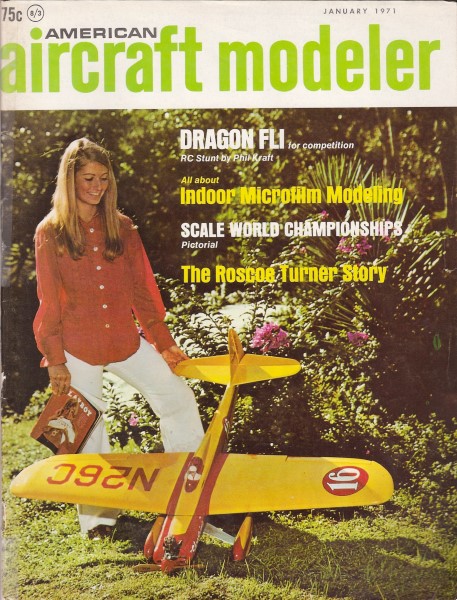
for a scan of Phil Kraft's Dragon-Fli pattern plane. It appeared in the January
1971 American Aircraft Modeler magazine on page 19. Precision / advanced aerobatics airplanes
have undergone a significant transmogrification from somewhat boxy outlines with
only slightly larger than normal control surfaces and retractable, tricycle gear,
to curvaceous tail draggers with fixed gear. Programmable radio with multiple throw
rates and control mixing have permitted a lot of freedom in the configuration of
the entire aircraft.
Dragon Fli
By Phil Kraft
All-out competition stunt ship by Phil Kraft - based on years of experience and
testing. Retracts recommended for best performance.
Pattern flying today is perhaps 97 per cent pilot and three per cent aircraft
design. However, the world's top fliers are so close in ability that the airplane's
three per cent can be decisive. There is no question that in the last two years
a trend has developed toward heavier, faster competition stunt models. After all,
a stunt performance is primarily intended to take maximum advantage of the human
factor in judging. At contests, fliers often comment that "so and so" put in a lousy
flight, but his spectacular performance biased the judges.
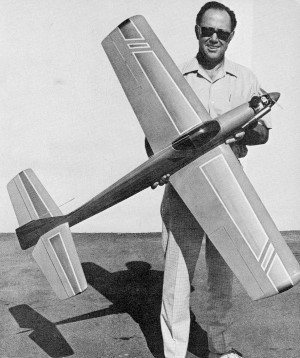
Author holds latest in his Fli series. It is sensitive, precise, fast and graceful.
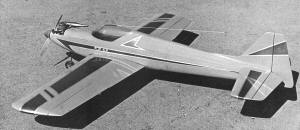
Editor's note: Dragon FIi's speed and airfoils need only small control surface
movements, proper balance. It can land quite slowly, too.
In my opinion, it is not possible to differentiate between the spectacular performance
and a properly performed sequence of maneuvers. Fliers are trying to paint a picture
and to create an effect. Thus, I have come to believe that the high-speed spectacular
pattern with large graceful maneuvers will be most effective in gaining maximum
points.
This new line of thinking has been a complete turnabout. The Kwik-Fli series
of designs was in exact opposition to the current trend. They were slower flying,
lightweight, rather unspectacular designs. The maneuvers were compact and had to
be tightly controlled to be effective. The Kwik-Fli emphasized reliability and consistency
above other factors. However, it was designed in an era when powerful contest engines
which also were reliable just weren't available. Today, there are several extremely
powerful engines with great reliability as well. Therefore, the design trend has
been made possible almost entirely by the availability of superior engines.
The Dragon Fli design is a development of the Slik-Fli-type fuselage, combined
with a newer wing design. Three different airfoils were tried during testing before
settling on a 15 per cent section with a maximum camber at about 40 per cent. This
low aspect ratio was selected primarily for ease of transportation. It does not
appear to have any deficiencies, and may have advantages as far as flight performance
is concerned. The deep fuselage of the Dragon Fli contributes to stability, particularly
in rough air. Like anything else, it also has disadvantages, such as in taxiing
in strong winds.
The plans show retract gear, and there is no question but what this is an absolute
necessity for contest flying today. Fliers used to think the effect of retract gear
was primarily psychological. However after having flown an airplane with retract
gear, I don't think I would enjoy going back to the fixed gear model again, despite
the headaches with the less than satisfactory retract gear units that are currently
available.
To sum up, the Dragon Fli is a sound design capable of competition performance.
Jim Edwards flew one to second place in this year's Nationals, and two others placed
in the top 20 qualifiers.
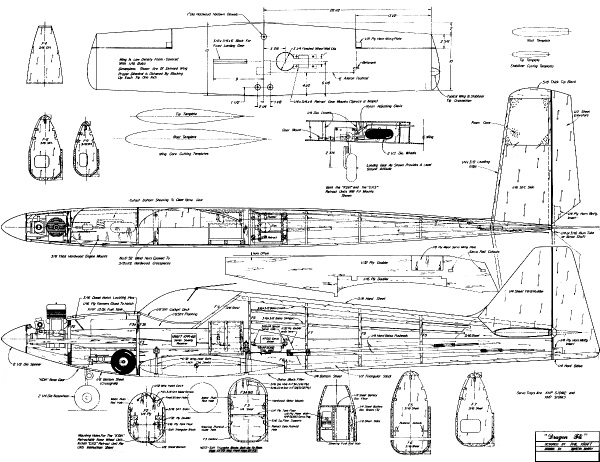
Dragon Fli Plans
Notice:
The AMA Plans Service offers a
full-size version of many of the plans show here at a very reasonable cost. They
will scale the plans any size for you. It is always best to buy printed plans because
my scanner versions often have distortions that can cause parts to fit poorly. Purchasing
plans also help to support the operation of the
Academy of Model Aeronautics - the #1
advocate for model aviation throughout the world. If the AMA no longer has this
plan on file, I will be glad to send you my higher resolution version.
Try my Scale Calculator for
Model Airplane Plans.
Posted January 30, 2023
(updated from original post on 2/11/2011)
|