|
I
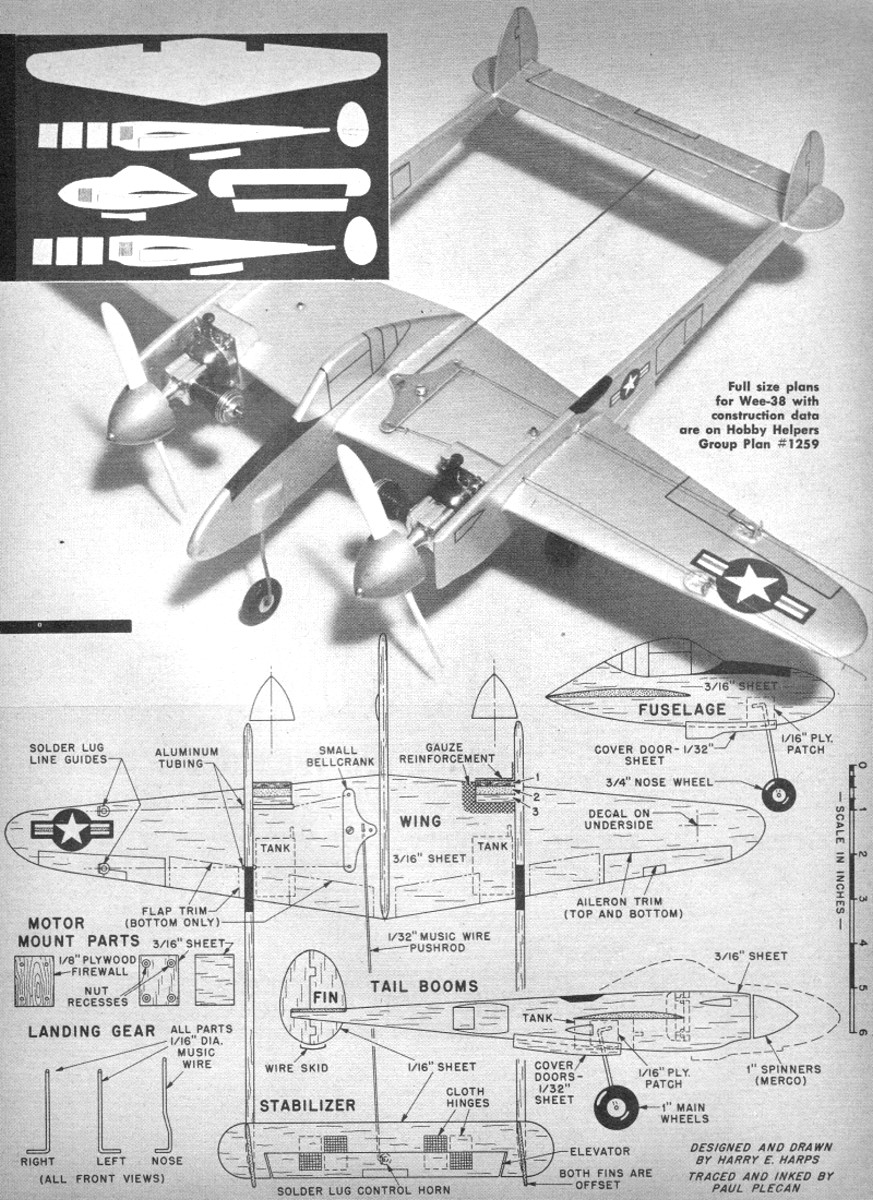
have always indented to build a multi-engine model of some sort,
but never have gotten around to it. With the plethora of ready-to-fly
(RTF) and almost RTF (ARF) models on the market today at very reasonable
prices, there is no real good excuse for not doing it; so I'll have
to stick with my bad excuses. But I digress. This simple twin "Wee-38"
Lightning uses a pair of Cox .020 or .049 engines and solid balsa
components. You could electrify the model with equivalent power.
P-38s make one of the nicer looking profile scale subjects because
of the twin tail booms and short fuselage. Wee-38
By Harry E. HarpsNow even us poor folks can afford
to fly a twin-engine control line plane and talk about piloting
pleasure...!
There's something about the appearance--at a flying circle-of
a twin-engined, U/Control plane that will draw the attention of
the most jaded enthusiast. Perhaps the crowd gathers to watch the
technique used to get and keep both motors going, or maybe they
congregate to absorb the music of two engines snarling in unison.
Whatever the reason - attraction and appeal are certainly there.
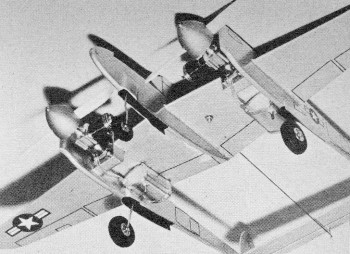 Sooner
or later every fan of this round-about sport has an urge to try
his hand with a dual motored ukie. A profile model satisfies the
need for an easily constructed plane that is strong enough to withstand
hard landings. Given a careful application of sandpaper, filler
and dope finish, details and proper insignia, a good looking, scale-like
appearance will result. Sooner
or later every fan of this round-about sport has an urge to try
his hand with a dual motored ukie. A profile model satisfies the
need for an easily constructed plane that is strong enough to withstand
hard landings. Given a careful application of sandpaper, filler
and dope finish, details and proper insignia, a good looking, scale-like
appearance will result.
Power available determines
size, which brings up the next problem. What power should be used?
A pair of oh-forty-nines is a logical choice, since their output
would equal that obtained from a single motor in the .074 to .09
range. Yet, the Cox .020 Pee Wee is intriguing and a power-packed
gem. There seems to be quite a few in circulation. Who hasn't bought
one just for kicks? Best of all, their small backplate simplifies
the mounting arrangement. Out of this cogitation came the tiny P-38
Lightning. First just a word about flight before we
wade into construction. Flight handling characteristics do not differ
from those of an ordinary ½A ukie. Line pull is certainly as great
with the twenty-eight foot, nylon lines, and breezy days call for
more cautious flying as usual.
Building data on full size plans.
WEE-38 BILL OF MATERIALS All sizes are in "inches"
and material is "balsa" unless otherwise noted. One 1/32 x 2 x 3
for landing gear caver doors; (1) 1/16 x 3 x 8 for fins and stabilizer;
(1) 1/16 x 5/8 x 2 1/4 plywood for landing gear reinforcement patches;
(1) 1/8 x 7/8 x 2 1/4 plywood for firewalls; (1) 3/16 x3 x
36 for wing, fuselage and tall booms. 1/16 music
wire for landing gear; .020 music wire for tall skids; .015 music
wire for leadouts; 1/32 music wire for pushrod; (2) 1" sponge wheels,
(1) 3/4" sponge wheel for landing gear; (8) 3/8" long 2-56 bolts
for mounting motors; (2) 1" long 3-48 prop mounting bolts; (2) 1"
prop spinners; (2) 3/8 oz. capacity fuel tanks; (2) 4.4" D by 2.5"
P props. Misc: small bellcrank; alum. tubing; solder
lugs; cloth hinges; gauze; filler; clear and colored dope; fuel
proofer; Pee Wee motors; lines; fuel and accessories.
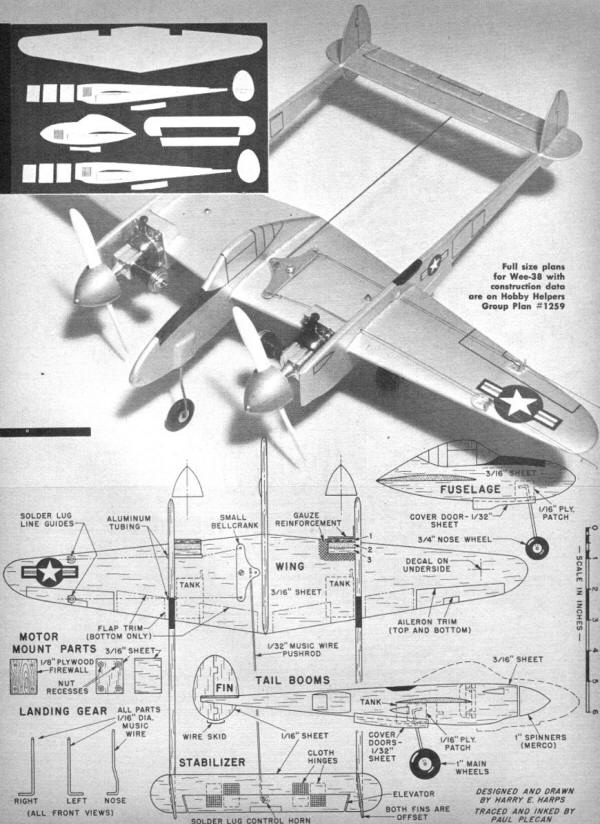 Wee-38 Lightning Plans
<click for larger
version>
Notice:
The AMA Plans Service offers a
full-size version of many of the plans show here at a very reasonable cost. They
will scale the plans any size for you. It is always best to buy printed plans because
my scanner versions often have distortions that can cause parts to fit poorly. Purchasing
plans also help to support the operation of the
Academy of Model Aeronautics - the #1
advocate for model aviation throughout the world. If the AMA no longer has this
plan on file, I will be glad to send you my higher resolution version.
Try my Scale Calculator for
Model Airplane Plans.
Posted August 7, 2011
|