|
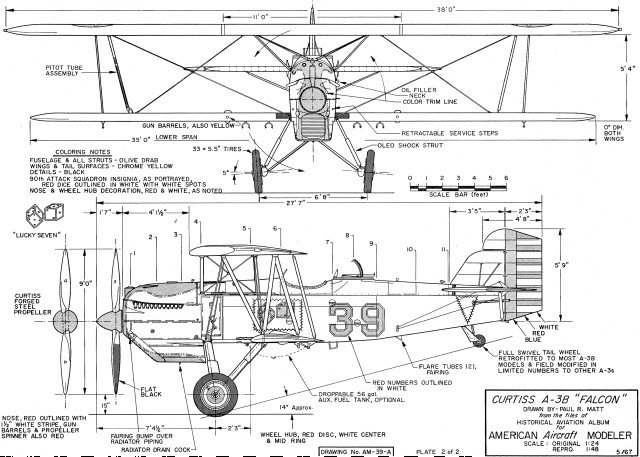
Here are plans for the Curtiss A-3B
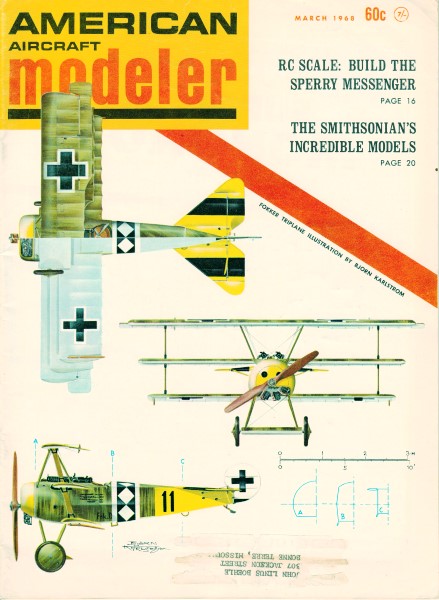
Falcon that I electronically scanned from my purchased copy of the March 1968 American
Aircraft Modeler magazine. You might be able to scale up the images below if suitable
plans cannot be located. Plans for this fine model were drawn by Mr. Paul R. Matt. All
copyrights (if any) are hereby acknowledged.
"The Curtiss Falcon is a family of military biplane aircraft built by the United States
aircraft manufacturer Curtiss Aeroplane and Motor Company during the 1920s. Most saw
service as part of the United States Army Air Corps as observation aircraft with the
designations O-1 and O-11, or as the attack aircraft designated the A-3 Falcon." - Wikipedia
Curtiss A-3B Falcon
Jack of all trades - master of a few - sums up the Falcon aircraft series.
by Paul Matt
Born
and bred at the Garden City facilities of the Curtiss Aeroplane and Motor Co. in 1924
and later produced at Buffalo, the Falcon sired many offspring. A number of attempts
were made to lump the Falcon series together as one with each used in different ways.
This is unfair to the historical significance of the basic design. Despite the many variations
and uses for which the Falcons were submitted and the strong family resemblance, each
type was different and each had its own personality. We cannot delve into the entire
Falcon line within this limited space. However, we can touch upon the development of
the A-3 Attack models.
Between 1924 and 1926 the Army Air Corps, for the first time, started a systematic
categorizing of its aircraft - thus the A-Attack, B-Bombardment, C-Cargo, O-Observation,
P-Pursuit, etc. designations. An extended program was undertaken to secure new aircraft
to fill these definite requirements. Prior to this, there were numerous unrelated designations
with an equal number of aircraft serving various purposes unsuccessfully.
In the fall of 1924 the Air Corps held several open competitions for new air-craft.
Among them were the requirements for a two-place observation aircraft to replace the
weary DH-4Bs. Private industry welcomed this opportunity to produce their own designs,
unhampered by McCook Field Ordnance and Engineering Department specifications. Basic
requirements were set forth. Certain military goals had to be met, but the industry had
a more liberal hand in the final concept. The only stringent stipulation seemed rather
ridiculous from the engineers' point of view; the power plant had to be the Liberty 12
engine of WWI vintage. This was an economy move by the military.
Eleven manufacturers competed at McCook Field. Each product was assigned

Notice:
The AMA Plans Service offers a
full-size version of many of the plans show here at a very reasonable cost. They
will scale the plans any size for you. It is always best to buy printed plans because
my scanner versions often have distortions that can cause parts to fit poorly. Purchasing
plans also help to support the operation of the
Academy of Model Aeronautics - the #1
advocate for model aviation throughout the world. If the AMA no longer has this
plan on file, I will be glad to send you my higher resolution version.
Try my Scale Calculator for
Model Airplane Plans.
|