Great Planes 2-Meter Spirit (and e-Spirit™)
Sailplane
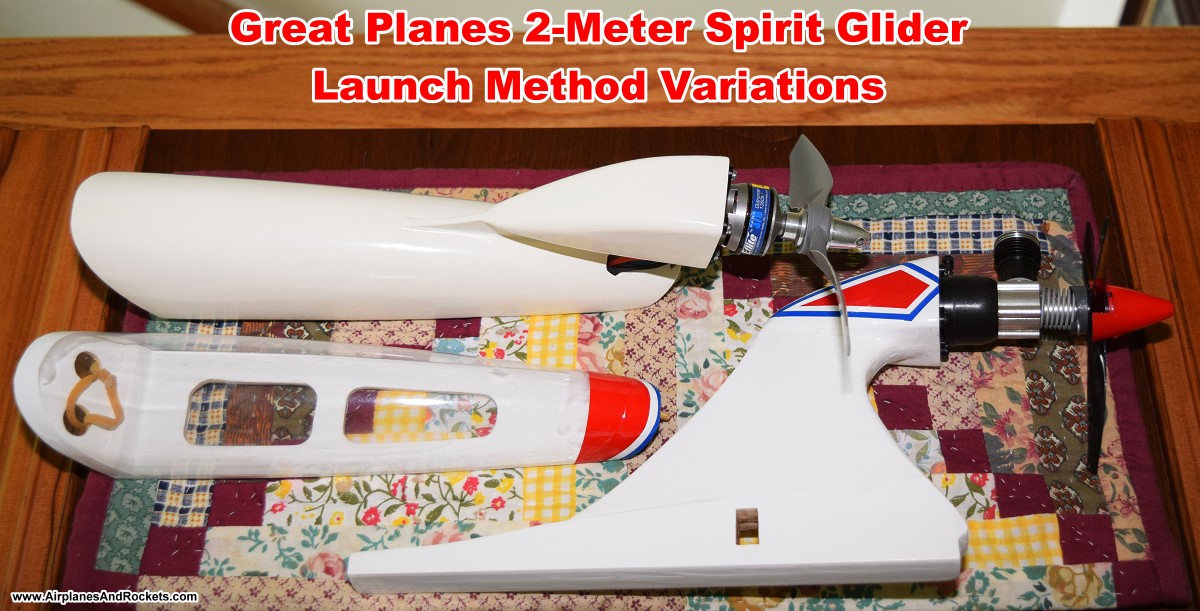
My newest 2-Meter Spirit sailplane has these three launch options
available with quick change-out capability. The stock canopy is for the towline configuration,
the Cox Black Widow .049 engine on the pylon slips on the wing joiner for glow fuel power,
and the canopy-mounted brushless motor installs in place of the stock canopy for electric
power. The only change required in the fuselage is nose ballast weight.
After looking at this page, you would be justified in concluding that I am a sales
agent for Great Planes because of the number of their 2-meter Spirit sailplanes that
I have had. Altogether, including ones I have modified in one way or another, there have
probably been about six or seven 2-meter Spirit gliders in the Blattenberger household.
Aside from the fact that the Spirit is generally a pretty good flyer (at least as good
as I need), one of my main motivations is the low cost. The first one I purchased was
in Hagerstown, Maryland, in 1992, for $35. Throw in a couple rolls of Monokote for $10
each, a bottle of CA, and a dab of epoxy for another $4 or so, and you are good to go.
Even at today's price of $50, it is still a pretty good deal.
Here is my new kit-bashed 2-Meter Spirit - the Aquila Spirit!
Wingspan: 2 m (78.5 in) Wing Area: 676 in2
Length: 39.2 in
Weight: 30 oz Wing Loading: 6.5 oz/ft2
While in Smithsburg, Maryland, we were fortunate
enough to live in the country where there were flying spots all around. A large field
across the road from our house allowed me to use either a short HiStart (UpStart) or
a power pod I built to sandwich between the two wing halves. A Cox .049 Black Widow took
it up about 500' and the pod + engine + propeller + weight barely
affected the performance at all. It actually
helped on windy days. To top off the perfection of my location in Smithsburg, about three
miles away was a road named Crystal Falls Drive, and just to the north of it was an open
slope that rose about 100 feet above the farm fields below (see photo to the left). That
was where my first successful slope soaring ever took place. I still beat myself up for
ever moving from Smithsburg, but, as they says, hind sight is 20-20. That Spirit was
sold prior to leaving Hagerstown.
As an aside, my house
also had a clear shot of the High Rock hang glider launching spot (click on thumbnail
to right). It was a small outcropping from amongst the trees that was 1000' above
the ground below. I loved watching the hang gliders soar up underneath the billowing
cumulus clouds and then finally touch down in the field across from our house.
My next 2-Meter Spirit was built while living in Colorado Springs, CO.
That was sometime around 1993. For some reason I do not have any pictures of it. It was
covered in white with transparent blue Monokote, like the one in Hagerstown. I flew it
a few times in school yards around Colorado Springs, and a couple times at the flying
site of the Pikes Peak Soaring Society. That 2-Meter Spirit was also sold prior to moving
about a year later to Melbourne, FL.
We eventually moved back up north, this time
to Syracuse, NY, where, along with a couple other models, I built yet another 2-Meter
Spirit glider, mainly to use as a training platform for my son, Philip. He and I are
shown to the left. As usual, a Futaba radio was installed in it. I bought an UpStart
catapult launching system for it. Philip did fairly well with it, but never had any interest
in flying model airplanes. So, after soloing a couple times, including a couple landings,
he never flew it again. That was about the end of my attempts to get him interested in
model airplanes. That Spirit met with an unfortunate end when the wing clipped a soccer
net pole during a landing. The school athletic fields are so full of equipment these
days that it is getting harder and harder to find a school with enough unobstructed area
to fly even a simple glider.
When
we moved to Loveland, CO, we had a huge cow field behind our house, so I purchased a
Great Planes Spectra kit, which is basically
a 2-Meter Spirit with an electric motor in the nose. It got many flights on it because
I could literally walk out my back door and launch it. Sally and Philip and I launched
quite a few Estes rockets from that field as well. That's me to the left in the cow
field in Loveland. To read about the Spectra and its ultimate demise - and to see a picture
of Melanie holding it instead of me - please click on the link above.
OK, so I built yet another Great Planes 2-Meter Spirit glider while living here in
North Carolina. Believe it or not, finding an open field around here in NC large enough
to stretch out a HiStart is difficult. Privately owned fields are usually off limits
any more because of liability issues (smack a lawyer the next time you see one and thank
him). After having my launch line land in a tree a few time, I decided to convert the
Spirit to electric. An order was placed with Tower Hobbies (they have been the recipients
of about 80% of my hobby money in the last 2 decades) for a Great Planes Triton charger,
two 1500 mAh Li-Poly battery packs, and a Master Airscrew 400 brushed motor w/3:1 gearbox
and 10x8 folding propeller. The motor/gearbox was much too large and pretty heavy. Dang.
I wanted to get a good brushless motor, but from what I could see, the
cheapest models Tower had at the time (circa 2001) started at around $120, and the special
brushless ESCs were about $80. Yesterday, Melanie and I went to
K/C Hobby in High Point, NC, and
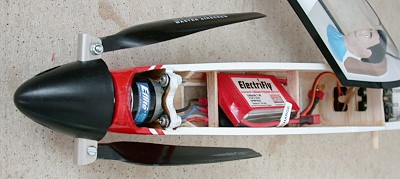
with the help of a knowledgeable fellow named Robert, we left with an E-flite Park 400
Outrunner motor ($55) and an E-flite 20-Amp Brushless Speed Control ($42). I think the
prices were excellent. I am utterly amazed at how much power is packed into that small
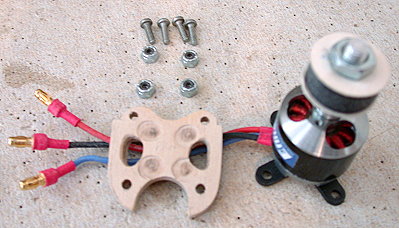
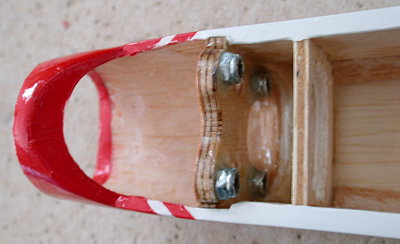
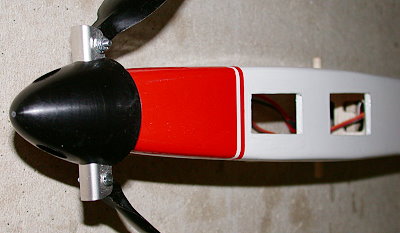
motor. Modifications have begun for the installation of the motor. I plan to use a couple
degrees of right thrust and down thrust as a starting point. I don't recall what
the Spectra used for thrust offset, but it did pretty well with the factory amounts.
Final ready-to-fly weight ended up at 32.6 ounces, compared to 31.5 ounces for the original
configuration.
We have been having a lot of wet and windy weather here in my area, but I couldn't
wait any longer. Yesterday (7-16-2005), I took the e-Spirit out and I gave it a 12 minute
and 20 second flight in very strong winds. Under power it just about hovered over the
same spot as I climbed in to the wind. Overcast conditions meant no thermals to seek
out, but I just wanted to make sure the darn thing would work - and work it did! with
the 1500 mAh Li-Poly battery, Elite Park 400 outrunner brushless motor & ESC, and
10x8 folding prop, it climbed at about a 45 degree angle all the way until almost out
of sight. After floating down and fighting the wind, I was able to make three more climbs
to about 500 feet after getting down to about 20 feet AGL. This is definitely a good
setup - it weighs only 1.1 ounces more than the original sailplane-only configuration.
Maiden Flight of the e-Spirit
Detailed photos of the modification are shown below.
Electrification of the Great Planes
2-Meter Spirit Sailplane
Here you can see where I expertly
landed the e-Spirit about 40 feet up in a tree near my house in Mt. Airy, NC, August
2007. My 20-foot extension ladder just barely got me up to the first branch. I tied a
rope to my belt and climbed the remaining 20 feet or so to where the Spirit was resting
totally unscathed in the branches. There was not even a hole in the Monokote. After removing
the rubber bands, the wing was lowered first on the rope so that Melanie could get it,
and then the fuselage made the descent. Finally, my 49-year-old body twisted its way
back down through the branches. Melanie stood with her finger on the 911 button on the
cellphone all the while.
A modification I made to the Spectra, I also made to this Spirit. It involves replacing
the rear part of the canopy that overhangs the leading edge of the wing with a built-up
fairing. That canopy overhang is easily damaged. Rather than allow the canopy to extend
beyond the rear canopy frame and over the top of the wing, the canopy is trimmed flush
with the frame, and a balsa fairing is built onto the wing. This provides what I consider
to be a nicer looking interface, and it exposes the canopy to less of a threat of damage.
A bulkhead is cut and shaped to match the rear of the canopy, minus 1/16" for sheeting,
then a single spine is cut to put in the middle that conforms to the airfoil shape and
provides a natural extension from the canopy shape. Finally, two pieces of 1/16"
balsa are glued in place, the gaps filled, and sanded to a final shape. The picture to
the right shows the finished product.
There has been some discussion on the modeling forums about the stock empennage
configuration being bad because of the way the rudder, with all its area being on top
of and in front of the elevator, tends to spoil the airflow over the elevator half on
the side the rudder is deflected. This effect is particularly magnified during a winch
or HiStart launch when the surfaces are at a high angle of attack. This photo to the
left shows my modified empennage. It has not been flown yet, but should perform well.
See the picture at the top of the page with supermodel Melanie holding the 2-Meter Spirit
with the empennage modification.
This is the parameter input screen for the MotoCalc software.
This is the MotOpinion screen that predicts the performance. It
turned out to be accurate.
About Airplanes & Rockets
Kirt Blattenberger
Even during the busiest times of my life I have endeavored to maintain some form
of model building activity. This website has been created to help me chronicle my journey
through a lifelong involvement in model aviation, which
all began in Mayo,
Maryland...
Copyright 1996 - 2026
All trademarks, copyrights,
patents, and other rights of ownership to images and text used on the Airplanes
and Rockets website are hereby acknowledged.



 When
we moved to Loveland, CO, we had a huge cow field behind our house, so I purchased a
When
we moved to Loveland, CO, we had a huge cow field behind our house, so I purchased a






 Here you can see where I expertly
landed the e-Spirit about 40 feet up in a tree near my house in Mt. Airy, NC, August
2007. My 20-foot extension ladder just barely got me up to the first branch. I tied a
rope to my belt and climbed the remaining 20 feet or so to where the Spirit was resting
totally unscathed in the branches. There was not even a hole in the Monokote. After removing
the rubber bands, the wing was lowered first on the rope so that Melanie could get it,
and then the fuselage made the descent. Finally, my 49-year-old body twisted its way
back down through the branches. Melanie stood with her finger on the 911 button on the
cellphone all the while.
Here you can see where I expertly
landed the e-Spirit about 40 feet up in a tree near my house in Mt. Airy, NC, August
2007. My 20-foot extension ladder just barely got me up to the first branch. I tied a
rope to my belt and climbed the remaining 20 feet or so to where the Spirit was resting
totally unscathed in the branches. There was not even a hole in the Monokote. After removing
the rubber bands, the wing was lowered first on the rope so that Melanie could get it,
and then the fuselage made the descent. Finally, my 49-year-old body twisted its way
back down through the branches. Melanie stood with her finger on the 911 button on the
cellphone all the while.
 There has been some discussion on the modeling forums about the stock empennage
configuration being bad because of the way the rudder, with all its area being on top
of and in front of the elevator, tends to spoil the airflow over the elevator half on
the side the rudder is deflected. This effect is particularly magnified during a winch
or HiStart launch when the surfaces are at a high angle of attack. This photo to the
left shows my modified empennage. It has not been flown yet, but should perform well.
See the picture at the top of the page with supermodel Melanie holding the 2-Meter Spirit
with the empennage modification.
There has been some discussion on the modeling forums about the stock empennage
configuration being bad because of the way the rudder, with all its area being on top
of and in front of the elevator, tends to spoil the airflow over the elevator half on
the side the rudder is deflected. This effect is particularly magnified during a winch
or HiStart launch when the surfaces are at a high angle of attack. This photo to the
left shows my modified empennage. It has not been flown yet, but should perform well.
See the picture at the top of the page with supermodel Melanie holding the 2-Meter Spirit
with the empennage modification.