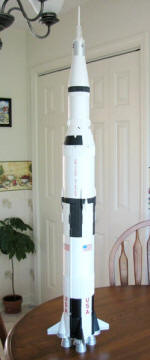
My Estes Saturn V Model Rocket
Just Added: The
Estes 1971 Model Rocketry
Catalog pages for most rockets.
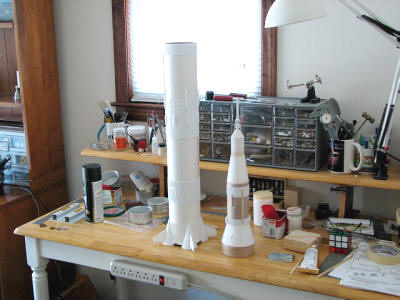
My latest pride and joy is an Estes Saturn V model. It was purchased at King
RC in August 2005, and finally completed in September 2007. I have wanted one of
these since childhood, but couldn't afford the cost back in the day (probably around
$25), and then just didn't have time during the college and child-rearing days.
Anyway, here she is in resplendent glory.
My model rocket interest began around 1970, when I was 12 years old. I'm not
certain where I first saw an Estes rocket, but once I did, I dove as deeply into
model rocketing as my not-very-deep pockets would allow. As with most endeavors,
working on a shoestring budget meant compromising on a lot of things, like making
early launching pads out of a straightened clothes hanger and literally holding
two "D" cell flashlight batteries together and touching the cable to the igniters
to the ends for a launch, but you do what you have to do. My hobbies provided the
incentive needed to find paying jobs after school and during summer vacation, so
that eventually I could purchase a for-real Estes launch pad complete with blast
shield and adjustable launch angles.
From the beginning of my model rocket building years until around 1976, when
I graduated from Southern Senior High School, in Maryland, I probably built and
flew at least half model rockets that Estes sold except for expensive ones like
the Saturn 1B and Saturn V, and the ones that used D−size motors. I don't
think the "D" motors were even sold when I first started. My favorites were the
multi-stage and clustered engine models.
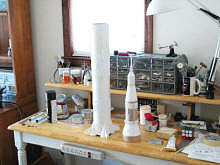
Estes Saturn V ready for painting.
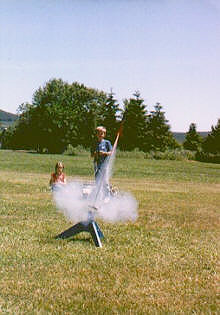
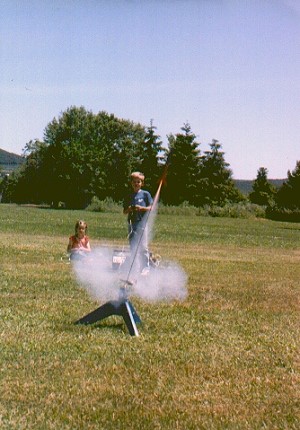
Philip Blattenberger launching his Estes Yankee model rocket.
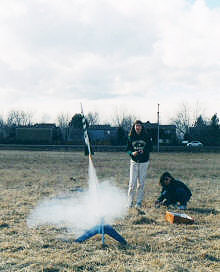
Sally Blattenberger launching her Estes
Gemini DC model rocket.
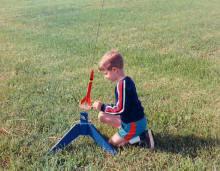
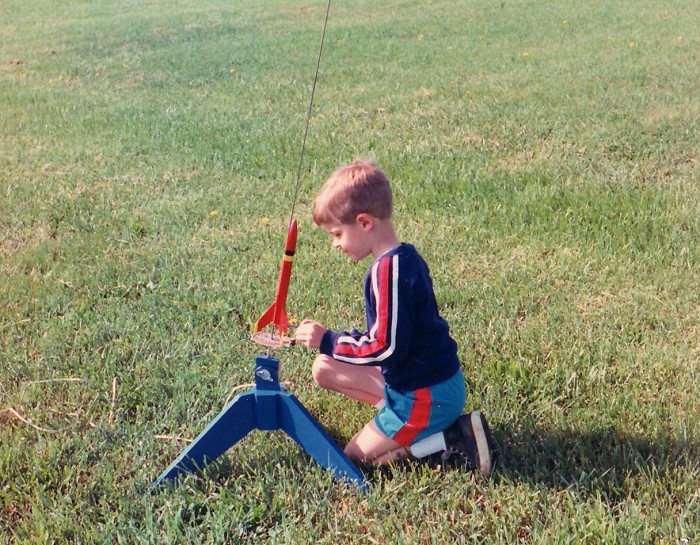
Philip Blattenberger preparing his Estes
Alpha model rocket.
Watching the stages separate was the coolest, but the possibility of a lost stage
was always possible if an observer was not used (yup, lost a stage in the tall grass
once). The Gyroc was also fun, and the Falcon rocket-glider was great. Once, I launched
a Scout featherweight that used tumble recovery; the ejection charge would shoot
the expended engine out the back and the model would tumble down unscathed. That
was a good method in theory, but on the first flight, I watched the engine fall
to the ground thinking it was the rocket, found the engine, but never found the
rocket!
Along with the models, I nose cones, body tubes, parachutes and launch lugs to
design and fly my own. All of the available Technical Reports were obtained and
read many times over. The one that showed the hands with missing fingers convinced
me to stick with factory-prepared engines and forego any thoughts of fabricating
my own out of match heads or liquid flammables. To this date, I have five fingers
on each hand and two functioning eyes (albeit dimmed from old age).
Unfortunately, my parents were not the picture taking types, so the only photos
I have are a couple I managed to take with other people's cameras. If they are ever
found, I'll scan them and post them here.
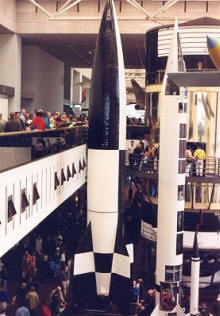
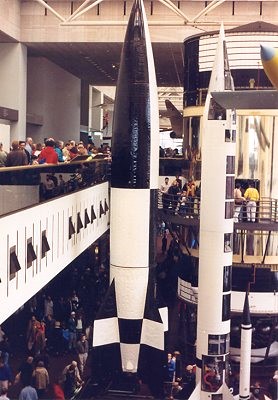
Captured German V-2 rocket at the National Air & Space
Museum.
Since becoming a father, I have attempted to instill my love for rockets
and all things that fly in my son, Philip, and daughter, Sally, but alas to no avail.
"Heavy sigh," as Mork would say. If you even know who Mork is, then chances are
you're an aging body like me.
When we lived in Colorado Springs (in the 1990s), I took the occasion to drive
down to Penrose, CO, and see the fabled Estes plant. It was a Sunday, so we couldn't
go in. I still remember one of the Technical Reports comparing the performance of
a rocket at sea level versus at the top of Pikes Peak, but had no idea what Pikes
Peak was at the time. While in Colorado Springs, I looked at its 14110 foot peak
every day.
Some day I would like to delve back into the model rocketeer world again. The
life-size models being built by many folks are inspiring and impressive, but sinking
the kind of time and money required is beyond my ambitions.
Model Rockets & Space Flight
|