|
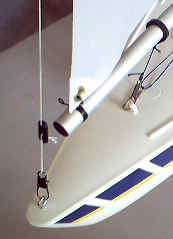 Rather than use the jib
sail as part of the mast support (as done by the manufacturer), a separate forestay
provides a much stronger and reliable structure. Rather than use the jib
sail as part of the mast support (as done by the manufacturer), a separate forestay
provides a much stronger and reliable structure.
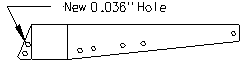 Begin
by removing the jib from the boat. Use an 0.036" (#63) bit to drill a hole in
the mast top as shown in the drawing. Exact location is not important, as long
as the hole is far enough from the edges and the other holes not to weaken the
mast top. This is where the forestay will be attached. Begin
by removing the jib from the boat. Use an 0.036" (#63) bit to drill a hole in
the mast top as shown in the drawing. Exact location is not important, as long
as the hole is far enough from the edges and the other holes not to weaken the
mast top. This is where the forestay will be attached.
Next, measure and
drill a 0.036" hole in the bow deck approximately 0.4" from the front and along
the centerline, as shown in the picture. Drill the hole at a rearward-leaning
angle that matches the line the forestay will make from the bow deck to the
mast top. There is plenty of plastic mass in the bow to guarantee a strong attachment.
Install a 1/4" screw eye in the hole, at the angle created when drilling
the hole.
Thread a piece of rigging string through the new 0.036" hole in the mast
top, and tie a "TYPE A" knot. Install a line adjuster and a snap near the lower
end of the forestay. Connect the snap to the screw eye and adjust the forestay
tension to achieve the proper mast alignment (leaning slightly rearward to affect
a slightly weather helm - very necessary for good tacking performance with the
Victoria).
Jib Modification
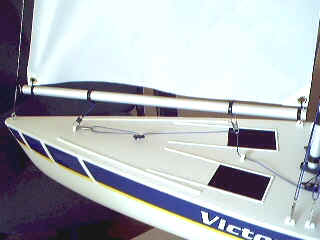 Adding a forestay requires a modification to the jib attachment
and rigging. Refer to the picture at the right when making the modifications. Adding a forestay requires a modification to the jib attachment
and rigging. Refer to the picture at the right when making the modifications.
Use a "TYPE B" knot to secure one end of a piece of rigging string to a snap,
and the other end to the forward-most jib boom ring. Adjust the rigging string
for 1/2" to 3/4" between the jib boom ring and the snap.
Position the jib boom ring approximately 3" back from the front of the jib
boom. Attach the snap to the forward deck eyelet. Fine adjustments to the jib
boom position is accomplished by sliding the jib boom ring back or forth.
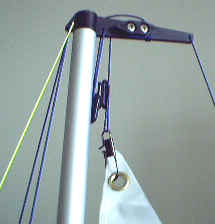 Use
a "TYPE B" knot to secure one end of a piece of rigging string to a snap, and
connect it to the top jib attachment point. Thread the rigging string through
the mast spreader and install a line adjuster. Next run the rigging string up
through the hole in the mast top closest to the boom, and use a "TYPE C" knot
to secure the rigging string to the mast top cleat. Use the line adjuster to
set enough tension on the jib sail to hold it in position. Use
a "TYPE B" knot to secure one end of a piece of rigging string to a snap, and
connect it to the top jib attachment point. Thread the rigging string through
the mast spreader and install a line adjuster. Next run the rigging string up
through the hole in the mast top closest to the boom, and use a "TYPE C" knot
to secure the rigging string to the mast top cleat. Use the line adjuster to
set enough tension on the jib sail to hold it in position.
Thread the jib sheet (control line) from where it attaches to the mainsail
sheet, through the bow eyelet in front of the mast and through a snap (attached
to the rear jib boom ring). Install a line adjuster and another snap for attachment
to the forward deck eyelet. Jib position adjustment is the same as the original
configuration.
Posted September 12, 2008
|